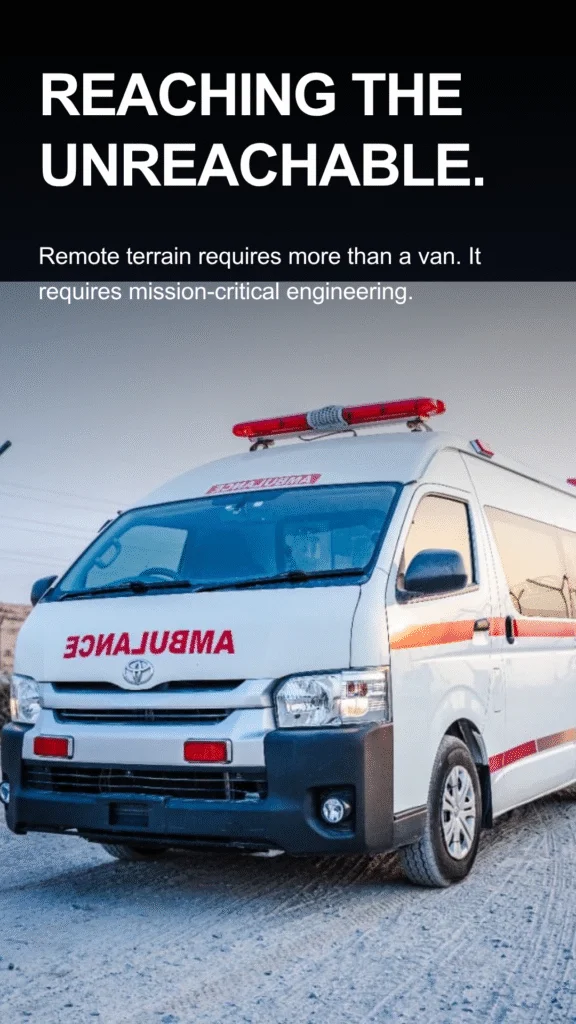
Standard urban ambulances fail far beyond paved highways. Sub-Saharan Africa and the Middle East have unforgiving terrains. Medical vehicles must be as resilient as the medical professionals inside them. Enter the Toyota Land Cruiser 78 series. For decades, it has been the undisputed king of off-road transit. Converted into a mobile clinic, it becomes an unstoppable lifeline. Welcome to the definitive Land Cruiser Ambulance Guide. We will explore why it is the gold standard for rugged medical transit. This comprehensive resource will detail the specialized exterior and interior conversions required by NGOs, governments, and private corporations operating in extreme conditions.
Why the Toyota Land Cruiser 70 Series?
Why is the LC78 the ultimate off-road chassis? First, it has unmatched mechanical durability. The LC70 series is famously over-engineered for the toughest conditions. It uses a heavy-duty ladder frame and solid live axles. Mechanical simplicity is its greatest strength in the field. You need a vehicle repaired easily with basic tools. Second, spare parts are available globally. This makes the Land Cruiser the top choice for the United Nations.
Finding parts is easy in remote Africa. Furthermore, the vehicle offers incredible 4×4 capabilities. Specifically, it features dual-range transfer cases and differential locks. As a result, the vehicle can easily traverse deep mud and loose sand. Consequently, it will not lose traction during a critical rescue mission.d loose sand. It will not lose traction during a critical rescue mission.
Base Chassis and Engine Specifications
Understanding engine options is a critical step in this guide. The LC78 usually features one of two legendary diesel engines.
The 1HZ 4.2L Inline-6 Diesel engine boasts a global reputation for immortality. Specifically, it produces immense low-end torque to conquer difficult off-road terrain. Additionally, it easily tolerates the low-quality diesel fuel found in remote regions.
The 1VD-FTV 4.5L V8 Turbo-Diesel offers another great option. This engine delivers massive horsepower and torque for highway passing power. However, it requires cleaner fuel and more meticulous maintenance routines.
Because an ambulance conversion adds significant weight to the vehicle, technicians must heavily upgrade the base suspension before deployment. Consequently, high-quality LC78 conversions feature heavy-duty leaf springs in the rear and upgraded coil springs in the front. This modification prevents sagging and smooths out the ride. Furthermore, reinforced, high-performance shock absorbers stabilize the patient completely while traveling over deeply rutted dirt roads.
Strict Adherence to EN1789 and ISO 13485 Standards
Safety and quality are non-negotiable in emergency medical transit. High-quality conversions must comply with strict international safety guidelines. The EN1789 standard regulates the design and testing of medical vehicles. It ensures that the patient compartment withstands severe 10G crash impacts. Every stretcher, monitor, and cabinet must remain securely anchored. Additionally, manufacturers must hold ISO 13485 certification. This standard governs quality management systems for medical devices. It ensures all installed life-support equipment functions flawlessly under stress. Never compromise on EN1789 and ISO 13485 compliance during procurement.
Exterior Conversions and Armor
A factory-standard Land Cruiser sometimes needs major exterior modifications, with the extended fiberglass high roof being the most noticeable and necessary change. A standard roof lacks vertical space for paramedics to stand. Exterior modifications are also strictly utilitarian.
Heavy-duty bull bars protect the radiator from animal strikes. A high-capacity electric winch allows crews to self-extract from mud. An elevated air-intake snorkel protects the engine from thick dust. It also prevents hydro-locking when crossing deep, flooded waterways. LED lightbars, scene lights for illuminating nighttime accidents, and heavy-duty sirens are permanently mounted securely to the roof.
Interior Medical Compartment Design
The interior balances off-road realities with strict hygienic demands. Extreme temperatures can degrade medical supplies quickly, so the walls and high roof use dense polyurethane foam insulation for maximum protection. This blocks out heat and dampens loud road noise. The cabin gets its own high-output air conditioning system. Cabinetry cannot use standard wood or cheap plastics. These materials splinter quickly and harbor dangerous bacteria. Quality conversions use fireproof, PVC-coated foamboard or lightweight aluminum. The floor uses heavy-duty, anti-slip, and anti-static marine-grade vinyl. It curves up the walls for easy washing. Because the vehicle experiences violent shaking, all medical cabinets feature specialized slam-locks to prevent life-saving equipment from flying out during transit.
Medical Equipment Integration

The LC78 supports both BLS and ALS configurations. Admittedly, space is naturally tight inside the cabin. However, efficient engineering creates a highly capable clinic.
Specifically, the rear features an auto-loading, heavy-duty stretcher. A shock-absorbing platform locks this equipment securely into place. As a result, this setup isolates the patient’s spine from harsh axle vibrations. Consequently, the design ensures maximum patient comfort during transit.
Additionally, a foldable squad bench sits opposite the main stretcher. Nearby, heavy-duty brackets secure dual 10-liter oxygen cylinders. From there, internal plumbing routes the oxygen to dedicated flow meters.
Furthermore, strong wall brackets hold vital ALS equipment. For example, these mounts secure automated external defibrillators and multi-parameter cardiac monitors. Finally, they also support mechanical transport ventilators and portable suction units.
Electrical and Power Systems
An ambulance is a very power-hungry machine, which means the standard Land Cruiser alternator and factory battery are entirely insufficient for operations. LC78 ambulances use an advanced Dual-Battery Management System. The primary battery strictly starts the vehicle’s engine. The secondary deep-cycle battery runs the medical compartment. An intelligent isolator charges both batteries while driving. It disconnects them when the engine is turned off. This prevents the starter battery from draining at a scene. Medical devices require standard wall-outlet power to function. A pure sine wave power inverter provides stable 220V/110V AC power. An external shore power socket allows the ambulance to plug into a hospital grid to keep batteries charged without idling the engine.
Procurement Checklist
Not all Land Cruiser conversions are created equal. Use this checklist when buying an off-road medical fleet. Ensure the fiberglass roof has an integrated roll-cage. Verify the suspension can handle continuous heavy payloads. Reject any build using standard wood for medical cabinetry. Confirm the inclusion of a high-capacity pure sine wave inverter. Ensure the vehicle conversion process and the onboard medical devices meet ISO 13485 and ISO 9001 quality management standards for safety.
Conclusion
Compromise is not an option in challenging environments. The Toyota Land Cruiser 78 provides an indestructible foundation. Expert conversions make it a life-saving mobile intensive care unit. This Land Cruiser Ambulance Guide outlines key mechanical parameters. Procurement officers can make informed decisions to maximize fleet uptime. Do not trust critical missions to unproven vehicles. Rescue Ride Africa specializes in these custom medical conversions. Contact our healthcare infrastructure architects today to get a custom quote for your next off-road ambulance fleet operating in rugged terrains.